
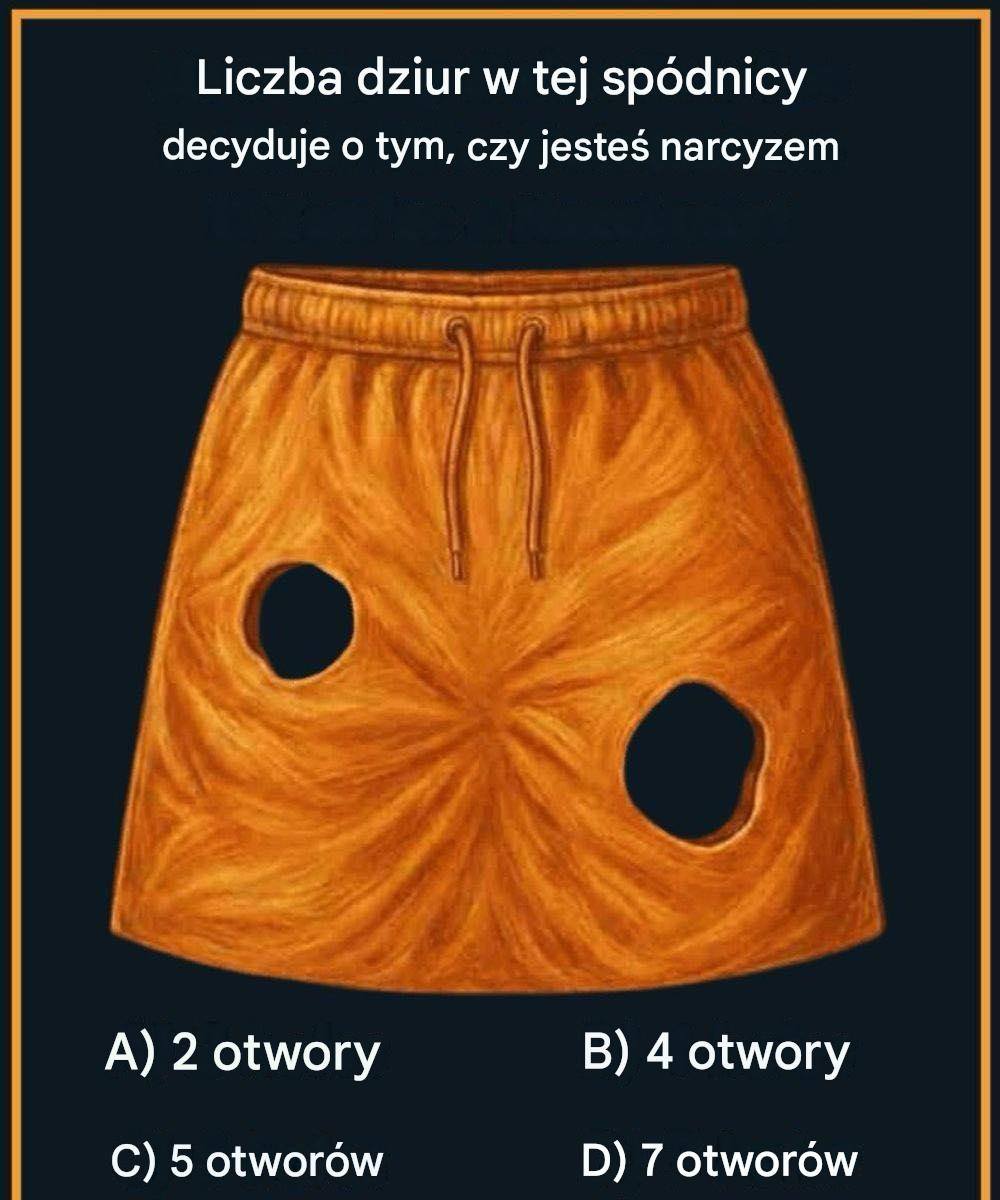
To właśnie tutaj zagadka staje się naprawdę interesująca i gdzie większość debaty faktycznie się toczy.
Pytanie wcale nie dotyczy spódnicy. Prawdziwe pytanie brzmi: co ty osobiście uważasz za dziurę?
Dla niektórych osób dziura to wyłącznie uszkodzony obszar. Łza. Rozdarcie. Coś, co nie powinno tam być. W tej definicji jedynymi dziurami wartymi uwagi są widoczne rozdarcia w tkaninie. Jeśli widzisz dwie łzy, mówisz: dwie dziury.
Dla innych otwór to każde otwarcie, przez które może przechodzić powietrze lub światło. To otwiera drzwi, można powiedzieć, do liczenia rozpięcia pasa, brzegu i wszelkich innych szczelin w ubraniu, niezależnie od tego, czy było to celowe, czy przypadkowe.
A dla tych, którzy myślą w kategoriach warstw tkaniny, każde rozdarcie liczy się dwa razy — raz na przedniej, raz na tylnej — ponieważ obie strony materiału zostały dotknięte.
Żadna z tych interpretacji nie jest błędna. To po prostu różne sposoby patrzenia na ten sam problem.
That is what turns this image from a simple counting task into a window into how different minds process information. Two people can look at the exact same picture, apply equally valid reasoning, and arrive at completely different totals.
That is not a flaw in the puzzle. That is the whole point.
Breaking Down the Most Popular Answers
Let’s walk through the reasoning behind each of the common answers people give, because understanding them helps you appreciate just how layered this little puzzle really is.
The answer of 2: This comes from the most literal interpretation. You see two torn areas on the skirt. Those are the holes. Full stop. This answer belongs to people who define holes strictly as damage.
The answer of 4: This comes from the fabric-layer reasoning. If each torn area goes through both the front and the back of the skirt, then each visible tear represents two actual holes in the material. Two tears times two layers equals four holes.
The answer of 6: This is where you add the natural openings of the garment — the top opening where you put the skirt on, and the bottom opening where your legs exit. Adding those two to the four from the torn areas gives you six.
The answer of 8: If you also count two small drawstring holes near the waistband of the skirt, you add two more to your total. Some versions of the image make these very small openings visible upon close inspection.
Each answer reflects a different but internally consistent way of thinking. That is what makes the puzzle so satisfying to discuss with others.
Why These Viral Visual Challenges Spread So Fast
There is a science to why certain images and puzzles go viral, and the skirt hole puzzle hits nearly every trigger.
First, it creates instant uncertainty. Most people expect to solve it quickly and are caught off guard when they hesitate. That moment of surprise is enough to make them pause and engage.
Second, it invites disagreement. Disagreement is one of the most powerful forces in online sharing. When people see different answers and realize others genuinely see the puzzle differently, the conversation takes on a life of its own.
Third, it is completely inclusive. Unlike puzzles that require trivia knowledge or specialized skills, this one asks only for observation and reasoning. Everyone feels qualified to participate, which means more people do.
And fourth, it is short. In a world where attention is the most valuable currency, a puzzle that delivers its full experience in under a minute has a massive advantage. People can try it, share it, and move on — but not before tagging a friend who they are confident will get it wrong.
What Your Answer Might Say About How You Think
Of course, no image can tell you everything about a person. No puzzle can reveal deep truths about character or personality with any scientific accuracy. The original framing of this puzzle used some playful language to suggest otherwise, but that was simply a hook to get people curious.
What the puzzle can offer is a gentle peek into your thinking style.
If you answered 2, you may tend toward directness. You see what is in front of you and you trust that observation. You are not likely to over-complicate something when the simple answer is right there.
If you answered 4, you are someone who naturally looks beneath the surface. You automatically account for layers and structure that others might miss. Detail-orientation is likely a strength of yours.
If you answered 6 or higher, you are a big-picture thinker. You do not just look at what is broken or obvious; you consider the whole system and every part of it. You probably approach problems in life the same way.
Again, this is all in good fun. But it is a reminder of something genuinely valuable: the way you approach a simple puzzle often mirrors the way you approach more complex situations in life.
The Joy of Thinking Out Loud Together